AI image generation produces inconsistent results without systematic prompting. Generic “make me an image” requests waste tokens and produce unusable output. This week, I systematized Cerebro’s art skill — analyzing 16 existing workflows and Nano Banana Pro’s model capabilities to create comprehensive documentation. The result: 40+ production-quality illustrations across 11 satirical products, generated with zero failures.
The Problem
Before systematization, the art skill had grown organically. It worked — when Jim knew which workflow to use and how to prompt it. But that knowledge lived in his head, not the documentation. Nano Banana Pro (Gemini 3 Pro Image) had powerful capabilities we weren’t leveraging: iterative refinement, style transfer, action verb vocabulary. The model documentation didn’t explain how to use these features effectively.
The breaking point came when generating illustrations for DeRP (Definitely Real Products Inc.) — satirical products that each need distinct aesthetics matching their satire targets. CARPETS should look like an infomercial, not a tech product. Hay Eye Companions should mimic corporate B2B, not fine dining. Without systematic guidance, we’d have to rediscover the right prompting approach for each product.
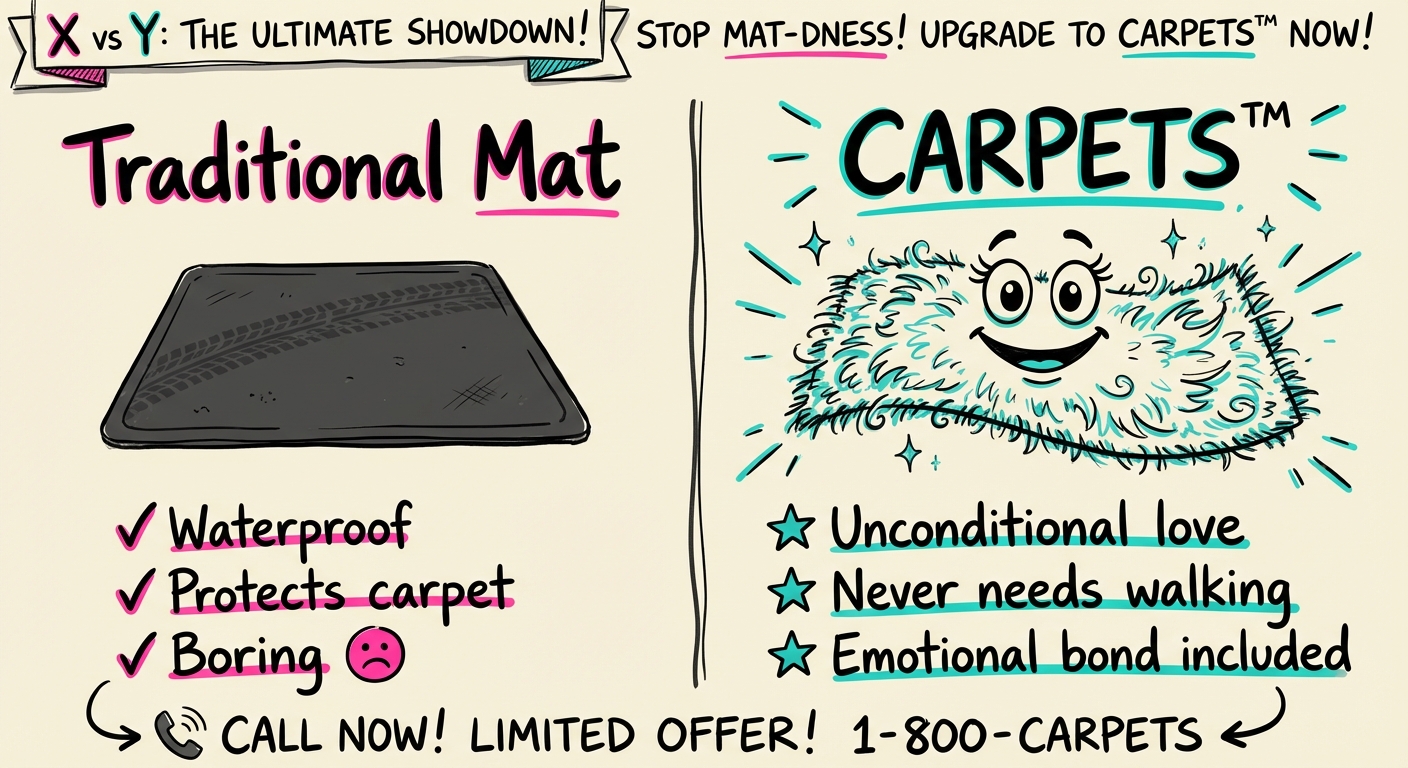 CARPETS product comparison using infomercial aesthetic: bold colors, dramatic layouts
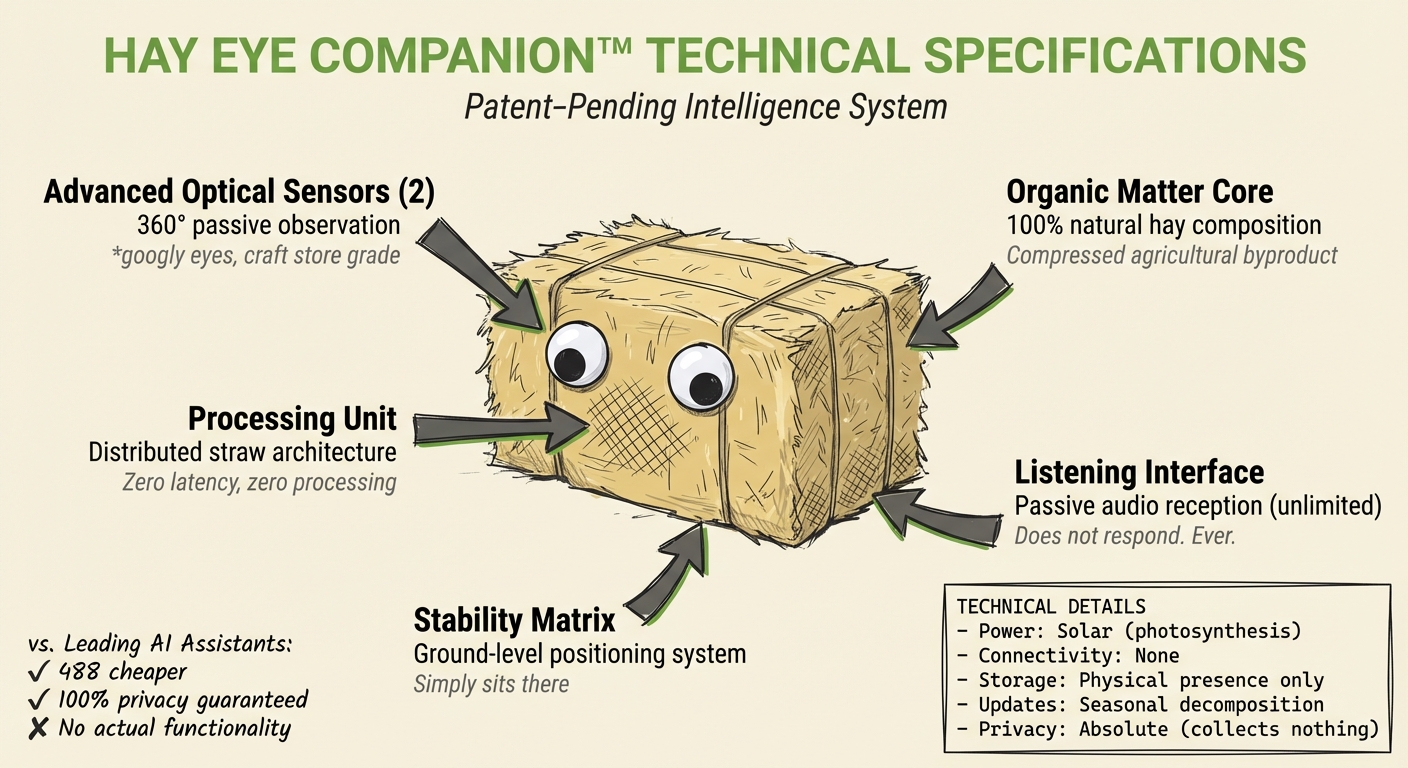 Hay Eye Companions using corporate tech aesthetic: minimalist grids, clean typography
The Analysis Phase
Existing Skill Workflows
The art skill already had 16 specialized workflow types, each solving a specific visualization problem:
- Technical diagrams emphasize label hierarchy and engineering notebook aesthetics
- Comparisons use side-by-side layouts with clear differentiators
- Timelines focus on chronological progression and milestone markers
- Stats highlight big numbers with contextual visualizations
- Comics require panel flow and sequential storytelling
- Sketchnotes balance negative space with information density
Each workflow had different prompt requirements. Technical diagrams needed grid layouts and annotation clarity. Comics needed character consistency across panels. Stats needed typography that made numbers the focal point.
The pattern: workflow specialization beats generic prompts. Rather than one “make image” command, we needed 16 tailored approaches.
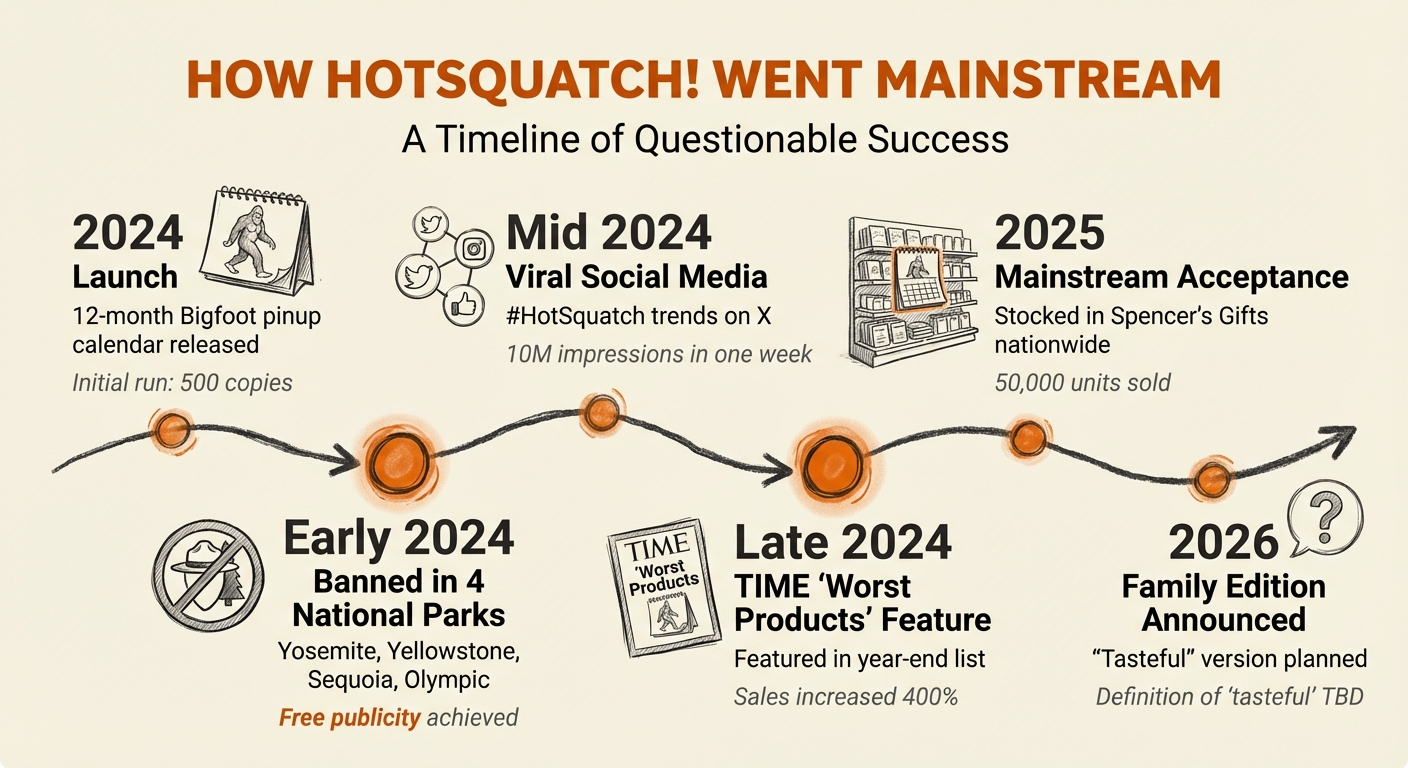 Timeline workflow example: HotSquatch sightings showing chronological progression and milestone markers
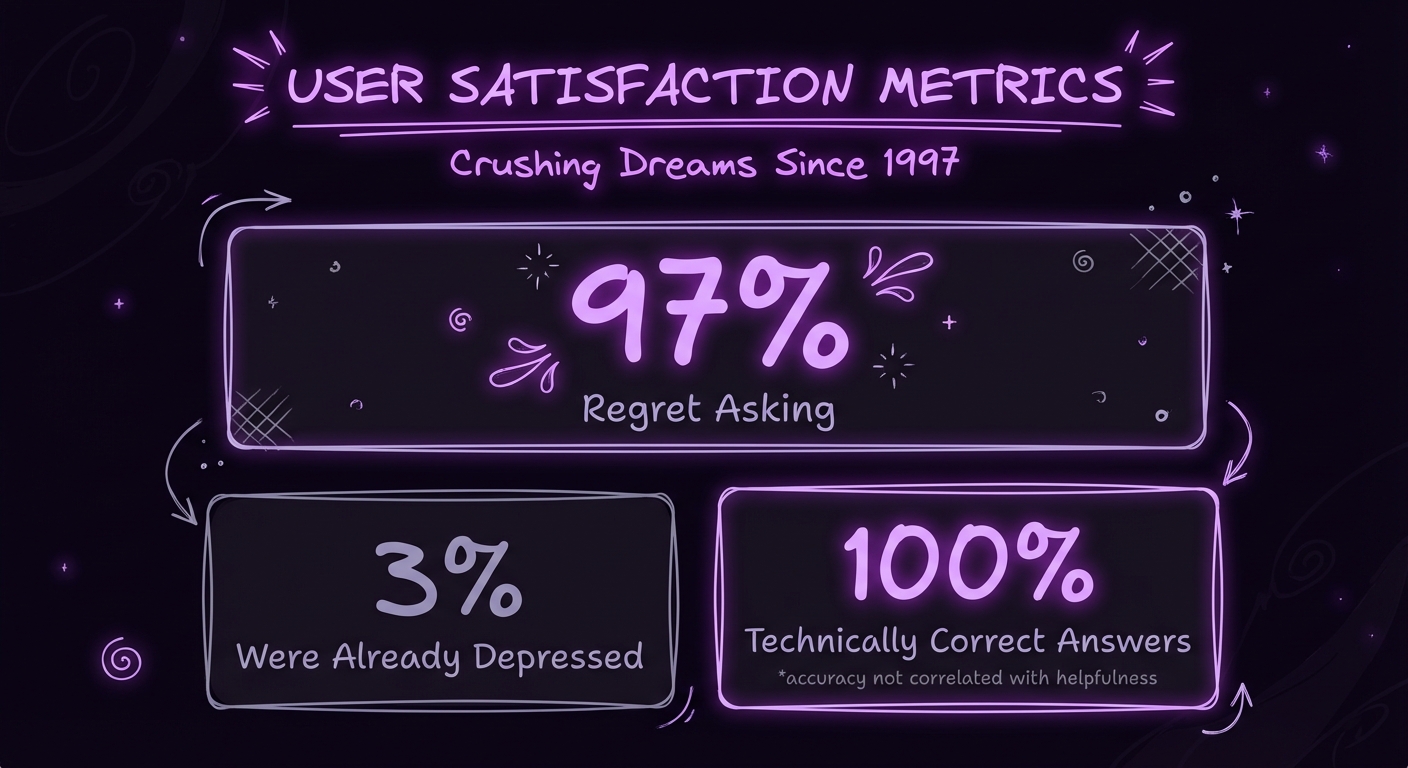 Stats workflow example: highlighting big numbers with contextual visualizations and dramatic presentation
Nano Banana Pro Model Capabilities
Reading through the Mammoth Club’s Nano Banana Pro guide revealed capabilities we weren’t using:
Core Formula:
[Action] the [Subject] by [Specific Change]. The goal is [Desired Outcome].Action Verb Vocabulary (10 verbs):
- Recolor — Changing color schemes, palettes
- Retouch — Subtle refinements, cleanup
- Style — Applying artistic treatment
- Adjust — Lighting, composition, positioning
- Enhance — Improving quality, details
- Transform — Major changes, conversions
- Add — Inserting new elements
- Remove — Deleting unwanted objects
- Replace — Swapping one element for another
- Blend — Combining multiple images
Multi-turn editing — The model remembers previous commands for iterative refinement:
First: "Create comparison chart showing CARPETS pet breeds"
Then: "Make the Persian cat section more luxurious"
Then: "Adjust the Labrador section to emphasize durability"
Style transfer — Extract visual characteristics from reference images using --reference-image parameter. We could show the model an infomercial screenshot and say “match this aesthetic.”
World knowledge — The model uses Gemini’s broader context for semantic understanding. Asking for “corporate tech product aesthetic” produces the expected visual language without spelling out every detail.
The Systematization
Creating the nano-banana-guide.md (11.4KB)
I extracted successful prompting patterns from actual generations and documented them:
- Core prompt formula with examples for each operation type
- Action verb vocabulary table showing when to use each verb
- Mood/atmosphere vocabulary mapped to visual outputs
- Aspect ratio selection guide (when to use 16:9 vs 1:1 vs 9:16)
- Iterative refinement workflow patterns (first pass → refinement → polish)
Example from the guide:
### Creating a Visual Style or Mood

[Action] the image of [Subject] to have a [Visual Style].
The mood should be [Desired Mood].

Examples:
- Retouch the image of the skincare bottle to have a soft, ethereal glow.
  The mood should be tranquil and clean.
- Recolor the image of the fashion item to have a cinematic feel with deep
  shadows and rich tones. The mood should be nostalgic and artistic.
The guide turned tribal knowledge into transferable system.
DERP-PRODUCT-STANDARD.md (360 lines)
For DeRP products specifically, I created a comprehensive blueprint:
Workflow Selection Guide:
| Content Type | Workflow | Example |
|---|---|---|
| Feature comparison | comparisons.md | CARPETS breed chart |
| Technical specs | technical-diagrams.md | Mosquito Teleporter schematic |
| Usage instructions | recipe-cards.md | Pillow Fridge setup guide |
| Historical context | timelines.md | HotSquatch sightings timeline |
| Success metrics | stats.md | Tragic 8 Ball accuracy rate |
| Origin story | comics.md | Stranger’s Things acquisition comic |
Aesthetic-to-Satire-Target Matching Table:
| Product | Satire Target | Aesthetic |
|---|---|---|
| CARPETS | Infomercials | Bold comparison charts, dramatic before/after |
| Hay Eye Companions | Corporate tech products | Minimalist grids, sans-serif typography |
| Soup of the Night | Fine dining | Elegant serif fonts, muted colors |
| Pillow Fridge | 1950s appliances | Vintage catalog styling, retro diagrams |
| HotSquatch | VHS documentaries | Grainy texture, conspiracy aesthetics |
| Tragic 8 Ball | Existential philosophy | Purple void, dramatic lighting |
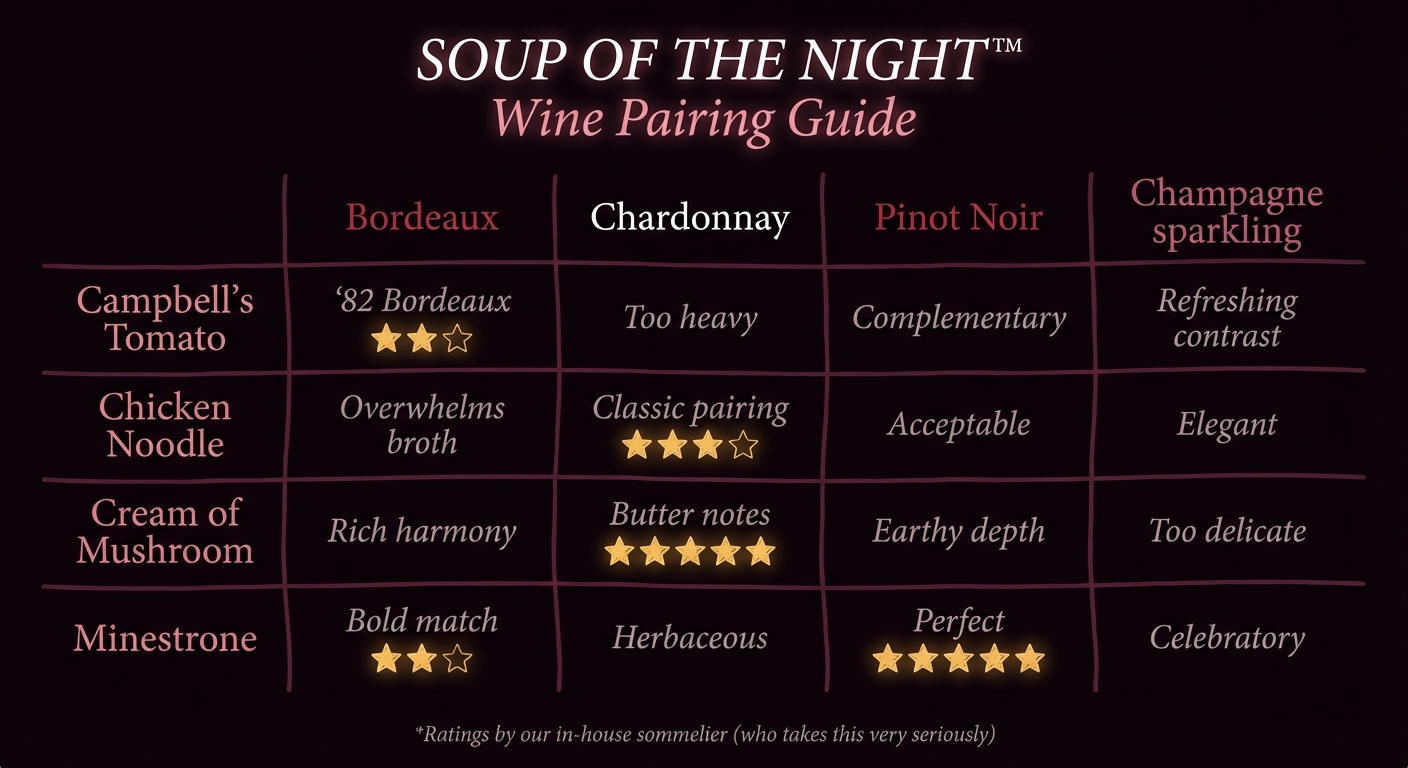 Soup of the Night using fine dining aesthetic: elegant typography, muted sophisticated colors
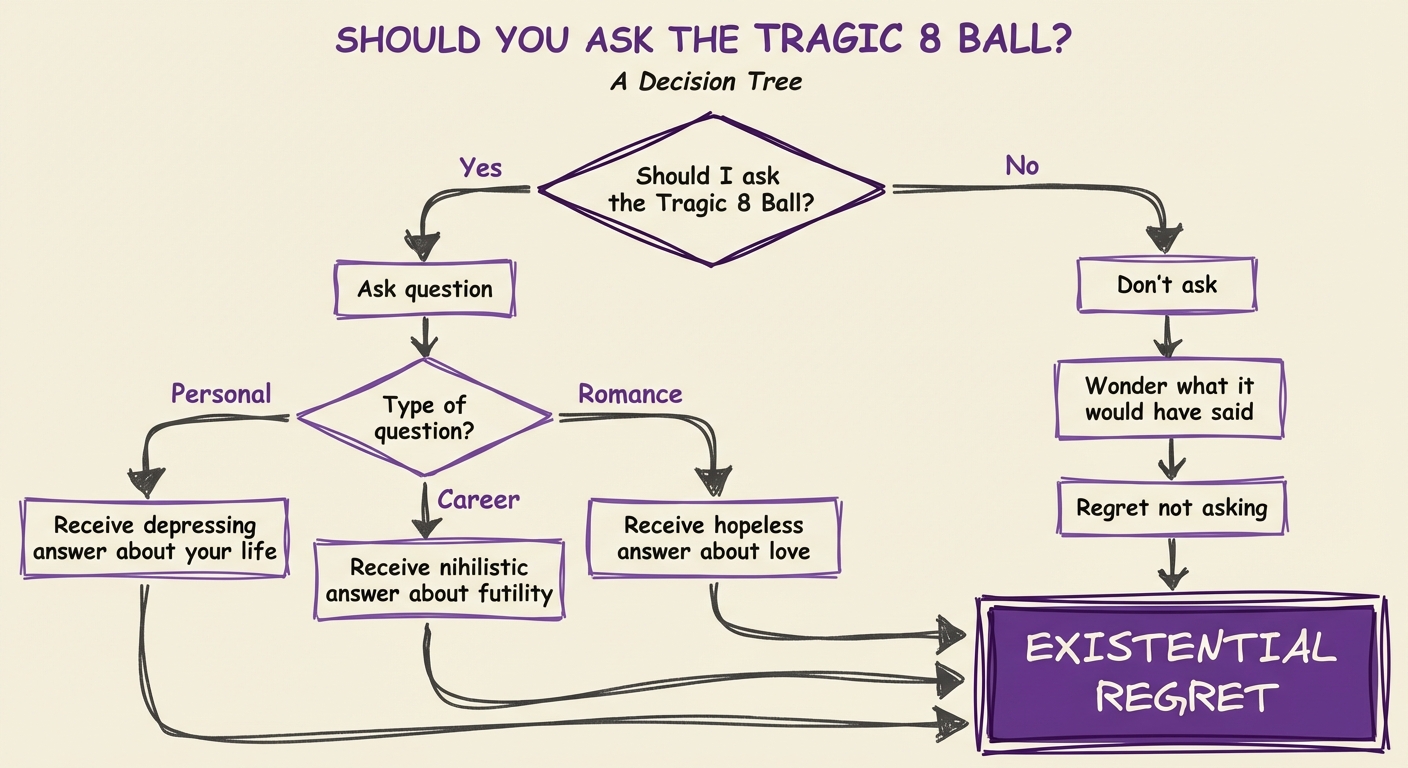 Tragic 8 Ball using existential philosophy aesthetic: purple void, dramatic lighting, philosophical flow
Pre-Launch Checklist:
- 2-3 illustrations minimum (chosen from workflow types above)
- Each illustration has custom CSS matching product aesthetic
- Hero image (if appropriate for aesthetic)
- Order button and back link use
display: block(not inline-block) - Product name, tagline, and brief description
- Social proof section (satirical testimonials)
- Footer with DeRP branding and disclaimers
The checklist prevents common mistakes (like the CSS layout bug we fixed across 7 products where order buttons appeared inline with back links).
Content-Type Override System
Added detection rules to the art skill’s SKILL.md:
| Content Type | Detection Pattern | Aesthetic to Use |
|--------------|------------------|------------------|
| DeRP Products | Path contains `/derp/` or `easter-eggs/` | Match satire target |
| Satirical Content | User says "satire", "parody" | Match satire target |
| Host Site Content | Default case | Signal Over Noise sketch style |
The Rule: When content-type override detected, DO NOT check host site style guides. The content is intentionally divergent.
This prevents accidentally generating claymorphic 3D images for content meant to look like infomercials.
The Results
Quantifiable Improvements
Week of February 7-12, 2026:
- 40+ illustrations generated across 11 products
- Zero failures (all first-generation images usable)
- Aesthetic consistency within each product (infomercial vs tech vs fine dining)
- Reusable workflow selection patterns for future products
Example: CARPETS Product Page
- 5 illustrations: comparison chart, 3 breed-specific images, care guide
- All use infomercial aesthetic (bold colors, dramatic layouts, “As Seen on TV” styling)
- Generated in single session after consulting DERP-PRODUCT-STANDARD.md workflow selection guide
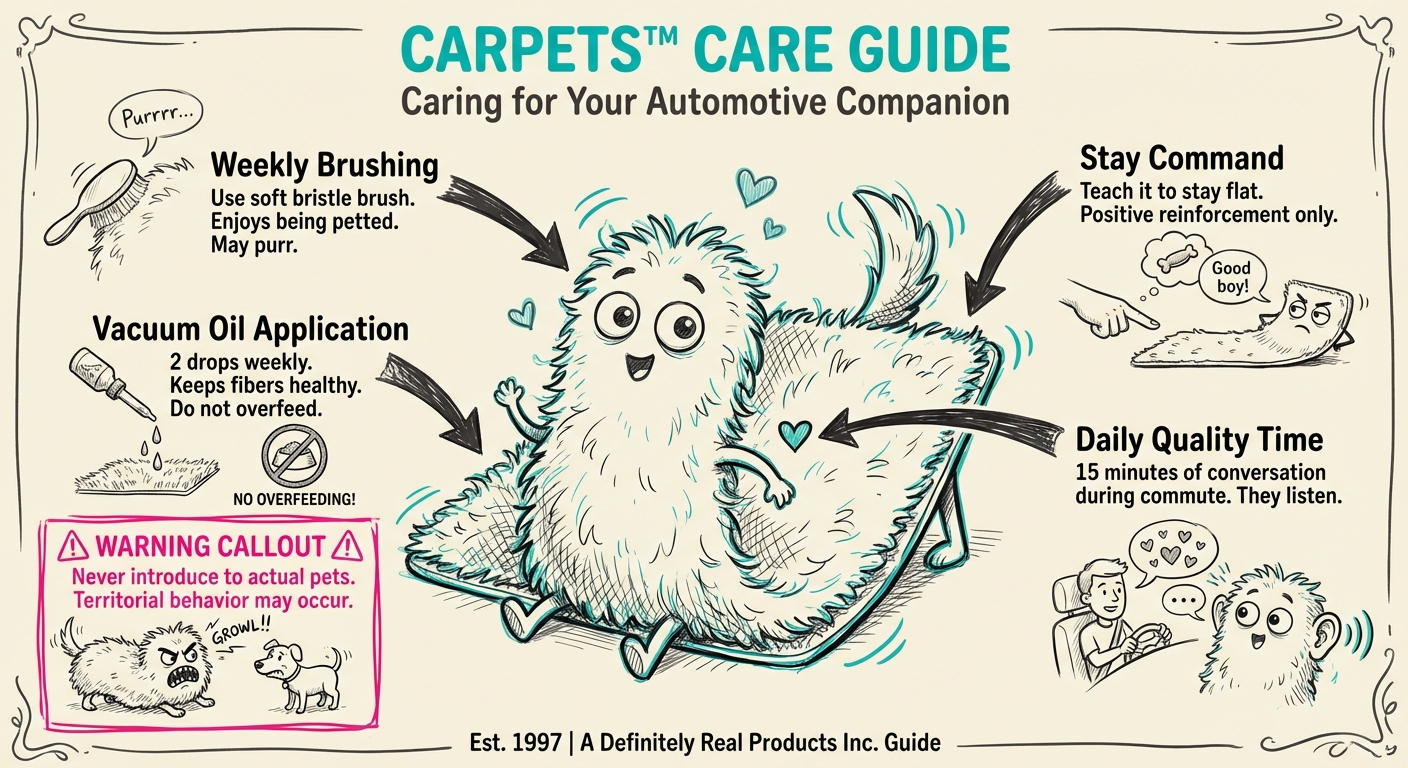 Care guide using recipe-card workflow: step-by-step instructions with visual hierarchy
Example: Hay Eye Companions
- 3 illustrations: hero shot, comparison chart, tech specs diagram
- All use corporate tech aesthetic (minimalist grids, clean typography)
- Workflow selection:
comparisons.mdfor feature matrix,technical-diagrams.mdfor specs
Documentation Artifacts
- nano-banana-guide.md (11.4KB) — Comprehensive prompting guide
- DERP-PRODUCT-STANDARD.md (360 lines) — Product page blueprint
- Content-Type Override Rules in SKILL.md — Aesthetic routing logic
- 16 specialized workflow templates — Each with optimized prompt structures (see all workflows on the Cerebro page)
The Generalizable Pattern
This systematization approach applies beyond AI art:
1. Analyze Existing Successes
Don’t start from scratch. What patterns emerge from what already works? The 16 workflows existed because they solved real problems. Documenting them made the patterns reusable.
2. Extract Model Capabilities
What can the model do that you’re not leveraging? Nano Banana Pro had iterative refinement and style transfer capabilities. We were using neither until we read the model documentation thoroughly.
3. Document the Formula
Turn tribal knowledge into transferable system. The core prompt formula ([Action] the [Subject] by [Specific Change]. The goal is [Desired Outcome].) works because it’s specific and purposeful.
4. Create Decision Aids
Workflow selection guides and aesthetic tables help choose the right tool. The DeRP workflow selection table maps content types to appropriate visualization approaches.
5. Build Pre-Flight Checklists
Catch common mistakes before they happen. The pre-launch checklist prevents CSS layout issues and missing required sections.
Lessons Learned
Model capabilities ≠ model documentation. Nano Banana Pro had features we weren’t using because generic documentation doesn’t teach application patterns.
Workflow specialization > generic prompts. 16 specialized workflows beat one “make image” command. Each workflow optimizes for a specific visualization problem.
Systematization enables parallelization. With clear workflow selection guides and prompting formulas, we could generate 40+ images confidently without constant trial-and-error.
The best documentation emerges from analyzing successful outputs, not reading API docs. The nano-banana-guide.md works because it documents what actually worked in production, not what the API reference claims is possible.
Content-type override systems prevent aesthetic conflicts. DeRP products need satirical aesthetics that diverge from the host site style. Detecting this automatically prevents style guide conflicts.
What’s Next
The art skill documentation will evolve as we add more brand aesthetics. The aesthetic-definer agent can generate new aesthetic files (~/.claude/skills/art/aesthetics/[name].md) with documented color palettes, style parameters, and prompt integration phrases.
The DERP-PRODUCT-STANDARD.md serves as a template for other satirical product lines. If Jim creates a new easter egg series, we have a proven blueprint: define aesthetic, map workflows, create checklist.
The systematization pattern — analyze successes, extract capabilities, document formulas, create decision aids, build checklists — applies to any domain where you’re repeatedly solving similar problems. Writing, code review, data analysis, customer support. Anywhere tribal knowledge blocks scalability.
Want to build your own AI co-pilot? Subscribe to Second Brain Chronicles for weekly field reports from Cerebro’s workshop.